


Open Mold Fiberglass Manufacturing
Flexible Fiberglass Manufacturing for Custom Parts
Not every fiberglass component requires a complex closed mold process. Open mold fiberglass manufacturing provides a versatile and cost-effective way to produce durable custom composite parts across a wide range of sizes, shapes and production quantities.
Fiberglass Specialties offers both fiberglass spray-up and hand lay-up manufacturing, allowing us to select the process that best fits your part, production requirements and budget.
From prototypes and replacement components to repeat production parts, our team can help turn your design into a durable fiberglass component built for its intended application.
What Is Open Mold Fiberglass Manufacturing?
Open molding is one of the most versatile methods of manufacturing fiberglass reinforced composite parts. Unlike closed molding, which forms the component between two mold surfaces, an open mold uses a single-sided mold that remains open during the application and curing process.
A release agent and surface finish may first be applied to the mold. Fiberglass reinforcement and resin are then applied using spray-up, hand lay-up or a combination of techniques. The material is consolidated against the mold and allowed to cure before the finished component is removed, trimmed and prepared for use.
Because open molding requires tooling for only one side of the component, it can offer lower tooling costs and greater flexibility than matched-mold processes for appropriate applications.
Fiberglass Spray-Up
Efficient Production for Durable Fiberglass Components
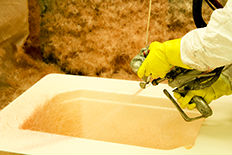
Fiberglass spray-up combines resin with chopped fiberglass reinforcement and applies the material directly to the mold surface.
During the process, continuous fiberglass roving is fed through a chopper gun, cut into shorter fibers and combined with resin as the material is deposited into the mold. The fiberglass and resin are then consolidated to remove trapped air and create the required laminate.
For appropriate components, spray-up provides an efficient way to build strong fiberglass parts while maintaining flexibility in part size, shape and thickness.
Advantages of Fiberglass Spray-Up
- Efficient application of fiberglass and resin
- Well suited for larger components
- Flexible laminate thickness
- Durable fiberglass construction
- Lower tooling investment than many closed mold processes
- Suitable for low-to-medium production quantities
- Can accommodate a wide variety of part sizes and geometries
Fiberglass Hand Lay-Up
Hands-On Manufacturing for Complex and Custom Components
Fiberglass hand lay-up provides exceptional flexibility for custom composite manufacturing.
Fiberglass reinforcement is positioned by hand within the mold and saturated with resin. The material can then be carefully worked into contours, corners and detailed areas before curing.
This hands-on approach gives experienced composite technicians considerable control over reinforcement placement and makes hand lay-up particularly useful for custom parts, complex shapes, lower production quantities and components requiring reinforcement in specific areas.
Advantages of Hand Lay-Up
- Excellent manufacturing flexibility
- Accommodates complex shapes and contours
- Allows targeted reinforcement
- Suitable for large fiberglass components
- Lower initial tooling costs
- Practical for prototypes and lower-volume production
- Ideal for many custom applications
Why Choose Open Mold Manufacturing?
A Practical Solution for Custom Fiberglass Parts
Choosing a manufacturing process isn’t about selecting the newest or most complicated technology. It’s about choosing the process that makes sense for the part.
Open mold manufacturing remains an important fiberglass production method because of its versatility.
For the right project, it can provide:
Lower Tooling Investment
Open molding generally requires tooling for only one finished surface, which can substantially reduce the initial tooling requirements compared with matched-mold manufacturing.
Production Flexibility
Open molding can accommodate prototypes, limited production runs and ongoing production without requiring the investment associated with some higher-volume manufacturing methods.
Size & Shape Flexibility
The process can be used for components ranging from relatively simple panels and covers to large, contoured fiberglass structures.
Custom Reinforcement
Fiberglass reinforcement can be added where additional strength or material thickness is required by the component’s design.
Durable Composite Construction
Fiberglass reinforced composites provide a valuable combination of strength, corrosion resistance, durability and relatively low weight for industrial and commercial applications.
Open Mold vs. Closed Mold
Which Process Does Your Part Need?
I’d definitely include this section because it gives us a natural internal link between the two SEO pages.
Neither manufacturing method is automatically better. The right choice depends on the component and how it will be produced.
Open molding may be appropriate when a project requires lower tooling investment, production flexibility, larger components or lower production quantities.
Closed molding, including RTM and LRTM, may be more appropriate when higher production quantities, tighter dimensional control, repeatability or finished surfaces on multiple sides are important.
And some projects may benefit from manufacturing approaches that incorporate characteristics of more than one process.
Not sure which process your component requires? That’s our job.
Custom Open Mold Fiberglass Parts
Your Design. Our Fiberglass Manufacturing Experience.
You don’t need to be a fiberglass expert before contacting Fiberglass Specialties.
Bring us your drawing, existing component, tooling, specifications or simply the problem you’re trying to solve.
Our team can evaluate your application and help determine the fiberglass manufacturing process that fits the component’s design, quantity, performance requirements and budget.
Whether your project calls for spray-up, hand lay-up, closed molding or another manufacturing approach, the goal is the same:
Produce a fiberglass component that works for your product and your production process.
From Prototype to Production
Fiberglass Specialties has manufactured custom fiberglass and composite components since 1992, serving customers with projects ranging from individual custom components to ongoing production.
Our experience across multiple fiberglass manufacturing processes allows us to approach your project based on what the component actually requires—not simply the process that’s easiest to manufacture.
Let’s Talk About Your Part
Have a fiberglass component you need manufactured? Send us your drawings, specifications or existing part and tell us what you’re trying to accomplish.