


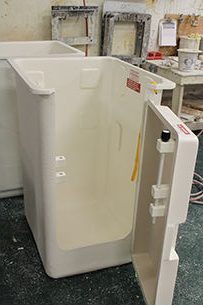
Closed Mold Fiberglass Manufacturing
Precision Parts. Consistent Results. Built for Production.
When your fiberglass components demand repeatability, clean finishes and efficient production, closed mold manufacturing provides a controlled solution.
Fiberglass Specialties, Inc. provides Light Resin Transfer Molding (LRTM) capabilities for custom fiberglass parts and components. From initial tooling through ongoing production, we work with manufacturers to produce durable composite parts designed around their application, assembly requirements and production needs.
Whether you’re developing a new component, replacing an existing manufacturing process or looking for a dependable production partner, our team can help determine whether closed molding is the right fit for your project.
What Is Closed Mold Manufacturing?
Closed mold manufacturing produces fiberglass reinforced composite parts between two mold surfaces. Reinforcement materials are placed within the mold before it is closed, and resin is introduced into the mold to saturate the reinforcement and form the finished component.
Because the part is formed within a controlled mold cavity, closed molding can provide greater part-to-part consistency, controlled dimensions and finished surfaces while reducing many of the secondary operations associated with open molding.
Closed molding is particularly valuable for manufacturers who need repeatable composite components across ongoing production runs.
ACMA recognizes LRTM among established closed-molding technologies and identifies tooling, vacuum systems, resin delivery, reinforcement and process control as key elements of LRTM production.
LRTM — Light Resin Transfer Molding
Efficient Closed Molding for a Wider Range of Production Needs
Light Resin Transfer Molding (LRTM) uses vacuum-assisted resin flow with matched tooling to manufacture composite components. It provides many of the benefits associated with closed molding while offering a tooling and production approach suited to a variety of fiberglass applications.
LRTM can be especially attractive when a manufacturer wants to move away from an open-mold process and needs better repeatability, cleaner finished parts and a more controlled production process.
Industry guidance from ACMA identifies LRTM as a variation within closed-mold/vacuum-assisted composite manufacturing and specifically addresses serial production, resin metering, tooling, vacuum systems and production-cycle control.
Benefits of LRTM
- Consistent, repeatable fiberglass components
- Good dimensional control
- Reduced secondary finishing
- Controlled resin distribution
- Improved surface quality
- Efficient production of repeat parts
- Reduced material waste compared with many manual processes
- Lower emissions than traditional open-mold processing
Closed molding is also used by composite manufacturers seeking improvements in product quality, manufacturing efficiency and workplace emissions.
Why Manufacturers Choose Closed Mold Fiberglass
Better Parts Can Mean a Better Production Process
The cost of a component isn’t limited to the price of the part.
Excessive trimming, inconsistent dimensions, difficult assembly and unnecessary finishing can add labor and slow production after a component reaches your facility.
That’s why Fiberglass Specialties looks beyond simply molding a fiberglass part. We consider how that part needs to perform in your finished product.
With the right component and production volume, closed mold manufacturing can help provide:
- Greater Consistency
Repeatable molding helps reduce variations from one component to the next. - Less Secondary Work
Cleaner, more controlled parts can reduce trimming, finishing and preparation before assembly. - Improved Fit
Better dimensional consistency can make components easier to integrate into your final product. - Production Repeatability
Once tooling and the manufacturing process are established, components can be reproduced consistently for ongoing orders. - Durable Composite Construction
Fiberglass reinforced composites provide an excellent combination of strength, durability and design flexibility for demanding applications.
Custom Closed Mold Fiberglass Parts
Built Around Your Product — Not Ours.
Fiberglass Specialties isn’t limited to a catalog of standard fiberglass components. We manufacture custom parts around our customers’ products and requirements.
Our team works with manufacturers on standalone fiberglass parts as well as components that become part of a larger finished assembly.
From tooling and mold development to repeat production, we can help take a component from concept to a manufacturing-ready fiberglass part.
F-SPEC’s existing capabilities include custom molds and patterns as well as standalone parts and components intended for assembly into customers’ end products.
Is Closed Molding Right for Your Part?
Not every fiberglass component needs to be manufactured using LRTM. Part geometry, production quantity, finish requirements, tolerances and end use all play a role in selecting the right process.
That’s where experience matters.
Fiberglass Specialties has worked with multiple fiberglass and composite manufacturing processes since 1992, allowing us to evaluate the application rather than force every project into the same manufacturing method. The company reports growing from roughly 500 parts annually at its start to more than 12,000 parts annually and operates more than 15,000 square feet of manufacturing space.
Have a Part in Mind?
Send us your existing part, drawing, mold or project requirements. We’ll work with you to determine the manufacturing approach that makes sense for your application.